As this project progressed and I struggled through the challenges of my inaugural foray into animation, two issues came to dominate my thinking. First was the way in which I was conceptualizing the intial study of the body in motion. The intial impulse for me was to take a very scientific approach. I was concerned with the accuracy of the inputs and the descriptive value of the derived model.
At some point, however, it became clear to me that our analyses of the body in motion were incredibly superficial and arbitrary. The reality of the situation reveals that no matter how many views we took, or how accurately we plotted points in 3-dimensional space, we could never perfectly describe the space through which these bodies moved. This realization was important to me in directing my investigation away from discrete, tangible objects to one in which I began harness the representational and design potential of animation.
This leads to the second issue - namely, what role did animation play in my design process? Was it merely the assigned media? Was I only using animation to describe what I had already done? Did it lead me down new paths, instill in me new ideas?
Of course, as my first shot with this new media, my narrow range of knowledge and experience limited my exploitation of animation's potential. However, I did begin to utilize its ability to describe not only the beginning and the end, but the in-between, as well. This change in thought is incredibly enlightening, as I can now, using animation, study, represent, and design processes, not merely discrete objects or views. Similarly, I now have a more accurate method by which to represent and design space, which exists in the "in-between".
[An obvious criticism of my latest animation, then, is that my models described actual, discrete moments, as opposed to depicting the fluid process of echoes.]
Monday, March 26, 2007

Tuesday, March 13, 2007


Sunday, March 11, 2007


Monday, February 26, 2007
virtual projection_version2
A more precise animation, sections are interpreted as snapshots, or discrete moments in time. In much the same way as a series of spatial sections can determine the form or sequence of a buidling, these "time sections" reveal the form and path of the bodies in motion. The concept of action and mimicry is further explored, as the two movements act in separate "time sections" and follow slightly different paths.


virtual projection_version1
Catherine Ingraham's essay comments on the inevitability of frame to influence the way in which one perceives or imagines a "scape." Here, a consecutive and animate frames engage the camera as it moves through them, transforming the perception of each subsequent frame. The frames were conceived as as series of sections that are in constant flux - each with its own unique transformation.


Sunday, February 25, 2007
lines and linearity
scenario: A child (who is too short) cannot see himself in the mirror until his mother props him up. This metaphor, used by Jacques Lacan to explain his mirror stage theory, is used by Ingraham to describe the relationship of architecture to both the human body and psyche. Until the boy is able to see himself in the mirror, he has neither knowledge of his own image or a sense of himself as "other" sited in the world. Only by being propped up is he put in the appropriate time (the time it takes light to travel between his eyes and the mirror) and space (the physical distance between the boy and the mirror) to understand these complex relationships. According to Ingraham, architecture is the prop that allows the mind to perceive the body.
"One might say that the architect tries to supply the insufficiency of the fragmented whole - the self and the body - by sketching the scaffolding as a web to keep us forever propped upright in front of our own image. Or, rather, the architect tries to hold us, using the force of lines, at the moment of meconnaissance, the mis-recognition that inaugurates our belief in the possibility of space and inhabitation."
Ingraham contrasts this view with one that spawned from the humanistic thought that man is inescapably separate from the world, but able to understand it through representation. Representation, however, necessitates translation, "connection and adequation," which are linear processes which assume that "mimesis (imitation of the world) is possible."
The problem here is that the world is always viewed through a frame (physical, psychological, cultural, etc.) that belies the notion that there is a linear connection between the perceiver and the perceived. Speaking architecturally, the line can be thought of as "lines of passage and division, the 'threshold' or boundary condition. . ." A more sophisticated view of threshold and boundary, reveal that a line is wholly inadequate to describe these conditions that can and should be engaged, not merely passed through.
Therein lies the fundamental difficulty with linear constructs. A line is without dimension and cannot be defined - it is a descriptor or an "apparatus." It is in the morphing ("bastardization) of pure, dimensionless lines into pairs that space is created. This is similar to the morphing of pure geometries into "impure" shapes, while still maintaining the essence of the original (a shape that maintains the roundness of a circle).
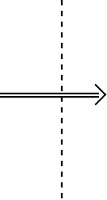
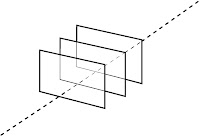
A pure line can only be passed through, but not engaged in the direction of its defining characterstic (its linearity) until it is morphed into two lines (It is a wonder then, that while walls are typically drawn as two lines, the thought of inhabiting the space within is not more common).


"One might say that the architect tries to supply the insufficiency of the fragmented whole - the self and the body - by sketching the scaffolding as a web to keep us forever propped upright in front of our own image. Or, rather, the architect tries to hold us, using the force of lines, at the moment of meconnaissance, the mis-recognition that inaugurates our belief in the possibility of space and inhabitation."
Ingraham contrasts this view with one that spawned from the humanistic thought that man is inescapably separate from the world, but able to understand it through representation. Representation, however, necessitates translation, "connection and adequation," which are linear processes which assume that "mimesis (imitation of the world) is possible."
The problem here is that the world is always viewed through a frame (physical, psychological, cultural, etc.) that belies the notion that there is a linear connection between the perceiver and the perceived. Speaking architecturally, the line can be thought of as "lines of passage and division, the 'threshold' or boundary condition. . ." A more sophisticated view of threshold and boundary, reveal that a line is wholly inadequate to describe these conditions that can and should be engaged, not merely passed through.
Therein lies the fundamental difficulty with linear constructs. A line is without dimension and cannot be defined - it is a descriptor or an "apparatus." It is in the morphing ("bastardization) of pure, dimensionless lines into pairs that space is created. This is similar to the morphing of pure geometries into "impure" shapes, while still maintaining the essence of the original (a shape that maintains the roundness of a circle).


A pure line can only be passed through, but not engaged in the direction of its defining characterstic (its linearity) until it is morphed into two lines (It is a wonder then, that while walls are typically drawn as two lines, the thought of inhabiting the space within is not more common).


Thursday, February 15, 2007
animation_revamp
Because of the aforementioned problems with EIAS, I decided to switch to FormZ. Here's an updated and vastly improved animation.
Subscribe to:
Posts (Atom)