Sunday, March 11, 2007

Monday, February 26, 2007

virtual projection_version2

A more precise animation, sections are interpreted as snapshots, or discrete moments in time. In much the same way as a series of spatial sections can determine the form or sequence of a buidling, these "time sections" reveal the form and path of the bodies in motion. The concept of action and mimicry is further explored, as the two movements act in separate "time sections" and follow slightly different paths.


virtual projection_version1

Catherine Ingraham's essay comments on the inevitability of frame to influence the way in which one perceives or imagines a "scape." Here, a consecutive and animate frames engage the camera as it moves through them, transforming the perception of each subsequent frame. The frames were conceived as as series of sections that are in constant flux - each with its own unique transformation.


Sunday, February 25, 2007

lines and linearity

scenario: A child (who is too short) cannot see himself in the mirror until his mother props him up. This metaphor, used by Jacques Lacan to explain his mirror stage theory, is used by Ingraham to describe the relationship of architecture to both the human body and psyche. Until the boy is able to see himself in the mirror, he has neither knowledge of his own image or a sense of himself as "other" sited in the world. Only by being propped up is he put in the appropriate time (the time it takes light to travel between his eyes and the mirror) and space (the physical distance between the boy and the mirror) to understand these complex relationships. According to Ingraham, architecture is the prop that allows the mind to perceive the body.

"One might say that the architect tries to supply the insufficiency of the fragmented whole - the self and the body - by sketching the scaffolding as a web to keep us forever propped upright in front of our own image. Or, rather, the architect tries to hold us, using the force of lines, at the moment of meconnaissance, the mis-recognition that inaugurates our belief in the possibility of space and inhabitation."

Ingraham contrasts this view with one that spawned from the humanistic thought that man is inescapably separate from the world, but able to understand it through representation. Representation, however, necessitates translation, "connection and adequation," which are linear processes which assume that "mimesis (imitation of the world) is possible."

The problem here is that the world is always viewed through a frame (physical, psychological, cultural, etc.) that belies the notion that there is a linear connection between the perceiver and the perceived. Speaking architecturally, the line can be thought of as "lines of passage and division, the 'threshold' or boundary condition. . ." A more sophisticated view of threshold and boundary, reveal that a line is wholly inadequate to describe these conditions that can and should be engaged, not merely passed through.

Therein lies the fundamental difficulty with linear constructs. A line is without dimension and cannot be defined - it is a descriptor or an "apparatus." It is in the morphing ("bastardization) of pure, dimensionless lines into pairs that space is created. This is similar to the morphing of pure geometries into "impure" shapes, while still maintaining the essence of the original (a shape that maintains the roundness of a circle).
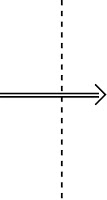
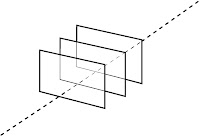

A pure line can only be passed through, but not engaged in the direction of its defining characterstic (its linearity) until it is morphed into two lines (It is a wonder then, that while walls are typically drawn as two lines, the thought of inhabiting the space within is not more common).


Thursday, February 15, 2007

animation_revamp

Because of the aforementioned problems with EIAS, I decided to switch to FormZ. Here's an updated and vastly improved animation.

Tuesday, February 13, 2007

_warped space

dystopianism - a society characterized by human misery, as squalor, oppression, disease, and overcrowding.

In Warped Space, Vidler successfully juxtaposes neoformations in architecture with the purer forms of functionalism to reveal striking and important differences in their respective zeitgeists.

Modernism was interested in standardization and efficiency in regards to its use of new technologies. The formal results of this line of thought are evident and resulted in a search for utopian, idealized spaces and relationships.

Firms like Morphosis are specifically challenging monochrome modernism and post-modern excess.

(I find it particularly ironic, then, that the people who architects such as Morphosis and Koolhaas are criticizing are the very people paying for these projects - dramatic buildings specifically calling out the excesses of corporatism)

Further, modernism’s interpretation of the human form was entirely about dimension and form (see Corbu’s Modular Man). The architecture of modernity, according to Vidler, is investigating the space of the mind, or “[the bodies] introjected projection.” (quote Morpheus from in the Matrix, “the digital projection of your virtual self”) Our “virtual selves,” as brought to us in neoformations, come complete with all of our fears, prejudices and “neurosis” included. The formal result is buildings like Coop Himmelblau’s UFA Cinema Center in Dresden, which, love it or hate it, is a challenging image of the contemporary human condition.


Monday, February 12, 2007

proj1b_test animation

This animation was created to experiment with Electric Image. It is an animation of model created for proj1a and, as described in the previous post, each frame attempts to create a figure/ground condition, framed views of the "void," and spatial and visual ambiguity.

I also had problems with the "polygonization" that would occure during the translation of models from Maya to FormZ. In the test animation, it ends up being interesting and ok, but in other models that ended up on Electric Image, the polygon forms interupted the smooth surfaces and resulted in "jumpy" animations.

I guess this week's beat down was administered not by the programs themselves, but in getting them to work together effectively.